STS-03: EASA's proposal for agricultural drones up to 750 kg
With NPA 2026-103 of 18 May 2026, EASA proposes STS-03, a standard scenario for visual line-of-sight flights with agricultural drones up to 5 m and 750 kg, within 20 m of the ground: an operational declaration would replace the authorisation. It is still a proposal and is not yet in force.
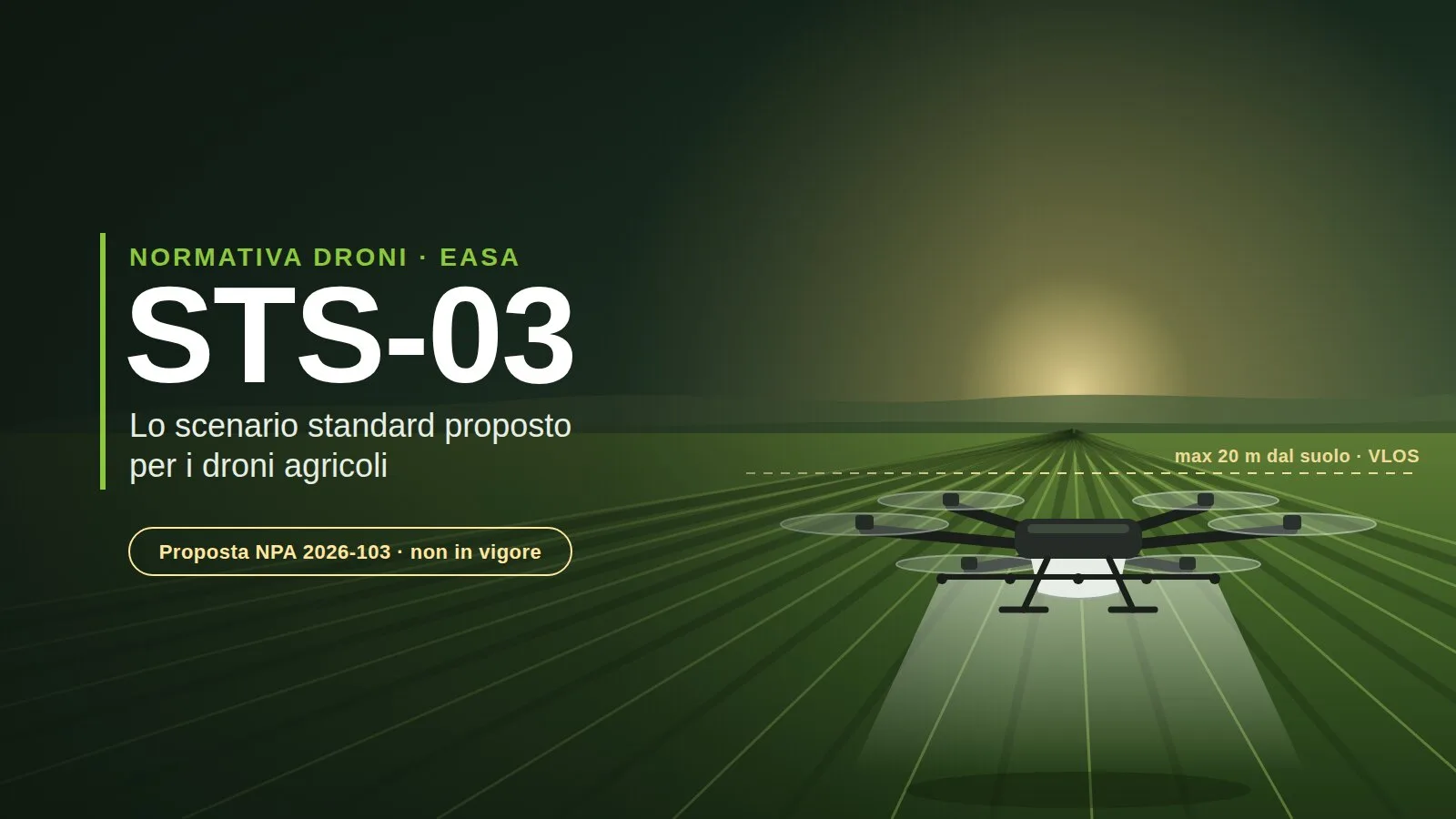
On 18 May 2026 EASA, the European Union Aviation Safety Agency, published proposal NPA 2026-103, which updates the European drone regulations (EU) 2019/945 and (EU) 2019/947. Among the changes is a third standard scenario, STS-03, designed for flights connected with agricultural, horticultural and forestry activities. The public consultation on the proposal closed on 8 June 2026.
How agricultural drones are flown today
Europe currently has two standard scenarios, STS-01 and STS-02, applicable since 1 January 2024. A declaration to the national authority (ENAC in Italy) is enough to fly, but drones must carry a class C5 or C6 label, which has a maximum take-off mass of 25 kg. Most spraying drones are heavier, so they fall outside these scenarios.
These drones need an ENAC operational authorisation in the "specific" category, based on a predefined risk assessment (PDRA) or on the SORA methodology. In August 2026 ENAC published AltMoC IT-UAS-2026-002, with a pre-filled compliance checklist and operations manual for agricultural, horticultural and forestry operations. The application becomes simpler, but the authorisation is still required.
What the proposal sets out
In the text of the NPA, STS-03 covers flights:
always within the pilot's visual line of sight (VLOS): EASA also considered beyond visual line of sight flights and excluded them;
within 20 m of the ground, or within 20 m above a natural or artificial obstacle, such as tree canopies;
with drones up to 5 m characteristic dimension, 750 kg maximum take-off mass and 15 m/s ground speed;
over land used for agricultural, horticultural or forestry activity, with take-off and landing in the same area;
over an area where the pilot does not expect any uninvolved people, and with no outdoor assemblies of more than 40,000 people within 1 km;
in uncontrolled airspace, unless the Member State sets different conditions through UAS geographical zones;
with a drone labelled C6 or C7, a new class introduced specifically for this scenario;
with a pilot holding the new "VLOS STS" (or "BVLOS STS") certificate.
As with the other standard scenarios, the operator would not apply for an authorisation: they would submit an operational declaration to the national authority and fly within the limits of the scenario and the manufacturer's instructions. The proposal also makes clear that spraying chemical products over the work area does not count as the transport of dangerous goods, but as aerial work carried out in that same area.
What would change for agricultural drone users
If STS-03 were approved in this form, many treatments that currently require an authorisation could be carried out with a declaration. For the heavier drones, however, the C7 label would be needed, and no drone can carry it today because the class does not yet exist. For drones in the DJI Agras range, as for those of other manufacturers, what will matter is the final set of C7 requirements and each manufacturer's decision to certify its models.
Not yet in force
STS-03 cannot be used today. After the consultation EASA prepares an Opinion for the European Commission, which then adopts the regulations. EASA has already published Opinion No 06/2026, but it covers only the security measures of the same update, such as operator registration and remote identification: STS-03 is not included. In the NPA, EASA works on the assumption that the new regulation enters into force on 30 June 2027. Requirements, the C7 class and dates may still change.
Flight rules and plant protection products are two separate matters
STS-03 concerns flight rules only. The use of plant protection products is governed by a different law: Directive 2009/128/EC prohibits aerial spraying, drones included, except for derogations assessed case by case. On 16 December 2025 the European Commission proposed amending it: products would have to be explicitly authorised for drone spraying, and Member States could grant derogations for drones considered safe for human health and the environment. Until these changes apply, a simpler flight scenario is not enough to carry out a treatment by drone.
We are following the process and will update this page when EASA publishes its Opinion on the simplification part. For questions about agricultural drones, please contact us.
Sources
EASA, NPA 2026-103 "Regular update of Regulations (EU) 2019/945 and (EU) 2019/947 — Simplification and security", 18 May 2026
EASA, NPA 2026-103 (A), Explanatory Note: paragraphs 2.3.3.4 (STS-03) and 2.3.8 (entry into force), PDF
EASA, NPA 2026-103 (C), proposed amendments to Regulation (EU) 2019/947: point UAS.STS.022, PDF
ENAC, Operazioni in ambito agricolo o forestale (in Italian)
ENAC, publication of AltMoC IT-UAS-2026-002 (in Italian)
European Commission, Application of drones to spray pesticides
Cover illustration created by Agrifutura.
Source: EASA
Read the sourceTechnical data and quotes: WhatsApp o 0523/945610.